How to Choose Protective Packaging for Fragile Items Shipped to Customers
· 7 min read · By Rob Puzio
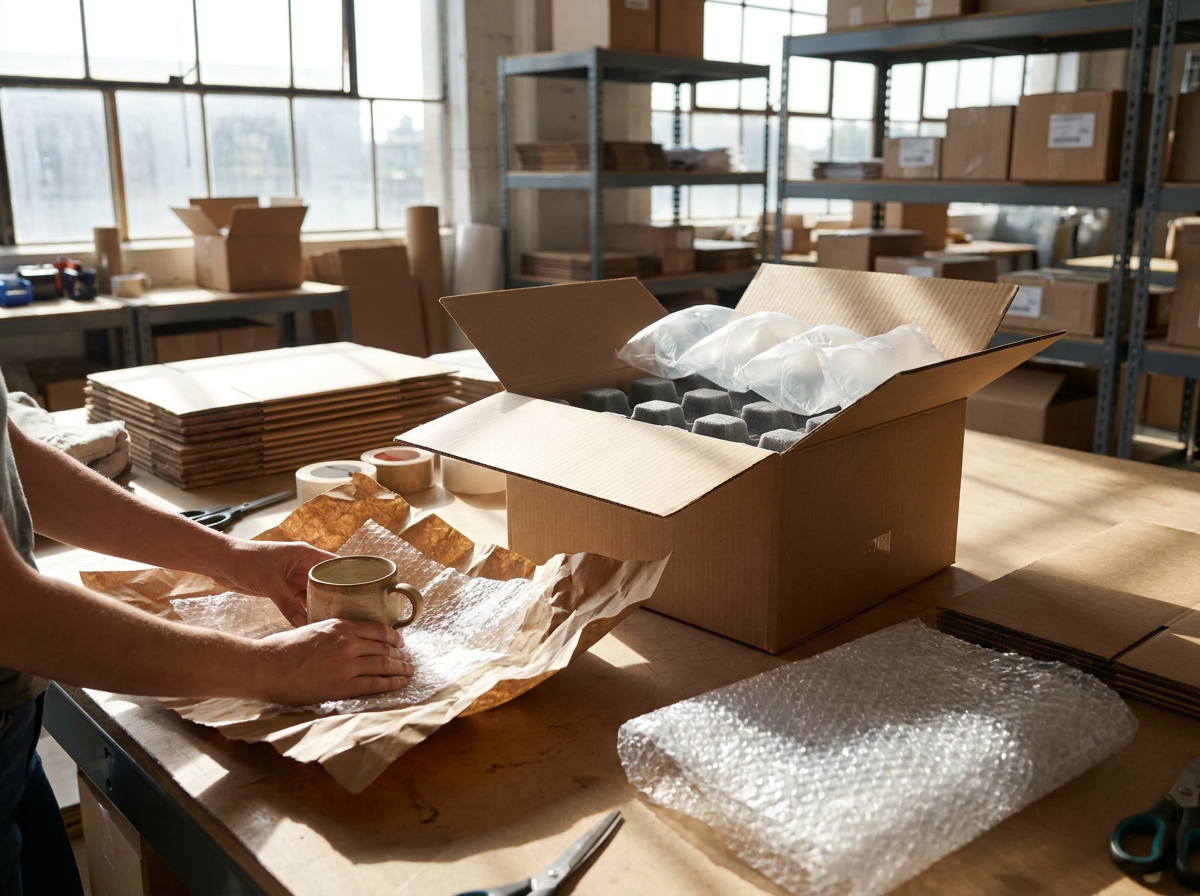
A broken item costs more than the product. You pay for the replacement, the return shipping and the customer who may not order again. Most damage comes from a few predictable problems: too much empty space in the box, the wrong cushioning, or a carton that cannot take the load. Here is how to choose protective packaging for fragile items so they arrive in one piece.
Start with how the item can break
Different products fail in different ways. Glass and ceramics crack from impact and point pressure. Electronics suffer from shock and vibration. Bottles can break from neighbors knocking together in the same box.
Write down what a failure looks like for your product. That tells you whether you need shock absorption, separation between items, or both.
- Impact: drops and corner hits during handling.
- Compression: weight stacked on top of the carton.
- Vibration: constant movement over long routes.
- Item-to-item contact inside multi-piece shipments.
Bubble wrap, foam, air pillows and paper
Each cushioning material has a job. Bubble wrap wraps tightly around odd shapes and gives good surface protection. Foam sheets and molded inserts hold a product in a fixed position. Air pillows fill space cheaply and weigh almost nothing. Crumpled or corrugated paper is a flexible fill that many customers can recycle.
- Bubble wrap: wrap each item directly, with extra layers on corners.
- Foam: best for electronics and high-value items that need to stay put.
- Air pillows: good void fill, but not a substitute for wrapping the product itself.
- Paper fill: flexible and recyclable, useful for lighter items.
Fill the void, but do not rely on fill alone
Empty space lets a product slide and hit the walls of the box. Fill every gap so the item cannot move when you shake the closed carton.
Void fill keeps things from shifting, but it does not replace direct protection. Wrap the product first, then use fill to hold it in place.
- Shake test: if you hear or feel movement, add more fill.
- Keep at least an inch or two of cushioning between the product and every wall.
- Do not overpack so tightly that the flaps bulge and the seal weakens.
Pick a box that fits the product
The carton is part of the protection. A box that is far too large invites movement and needs more fill. A box that is too small leaves no room for cushioning.
Use sturdy corrugated board rated for the weight, and consider double-wall construction for heavy or very fragile contents. For items that cannot touch each other, use dividers inside the box.
- Choose a box with room for cushioning on all sides.
- Use dividers for bottles, jars and glassware.
- Step up to heavier board for heavy items or long routes.
Seal the carton properly
A well-packed box can still fail if the seal opens. Run tape the full length of the center seam and down each end panel, and add edge seams on heavier cartons.
A carton that stays closed also keeps the cushioning where you put it.
- Use carton sealing tape sized for the load.
- Apply an H-pattern on heavy or fragile boxes.
- Avoid reusing worn boxes for fragile goods, since the board may already be weakened.
Label the package so it is handled correctly
Handling labels do not guarantee gentle treatment, but they help. Put the shipping label on a flat, clean surface where it scans, and keep it off tape seams and edges.
As a Florida label manufacturer with over 40 years of experience, we print custom and barcode labels in-house, with proofs within 24 hours. That includes fragile and handling labels sized for your cartons.
- Place barcodes on a flat panel, not across a seam.
- Use labels made for your carton surface and conditions.
- Keep branding and handling instructions consistent across shipments.
Related: Barcode labels · Custom product labels
Get packaging supplies and labels from one Florida source
We are a Florida manufacturer with over 40 years in the label industry, and we also supply protective packaging, boxes, tape and other shipping supplies at competitive prices. We are open 8am to 8pm, seven days a week, so you can reach a person when you have a question.
Tell us what you ship and how it travels, and we will help you pick the right materials and labels.
Related: Get a free quote
Frequently Asked Questions
What is the best protective packaging for fragile items?
It depends on the product. Wrap each item in bubble wrap or foam, then fill remaining space with air pillows or paper so nothing can move inside a sturdy box.
How much space should be between a fragile item and the box wall?
Leave room for cushioning on every side, commonly an inch or two. The closed box should not allow the item to shift when shaken.
Is void fill enough on its own?
No. Void fill stops movement, but the product still needs direct wrapping or a molded insert to absorb impact.
Can you supply labels along with packaging supplies?
Yes. We print custom and barcode labels in Florida and also offer packaging and shipping supplies. Request a free quote to get started.
Need Custom Labels or Packaging Supplies?
Florida manufacturer, 40+ years of experience, proofs in 24 hours. Open 8am to 8pm, seven days a week.
Get a FREE Quote