How to Choose Custom Labels for Plastic Bottles and Containers
· 7 min read · By Rob Puzio
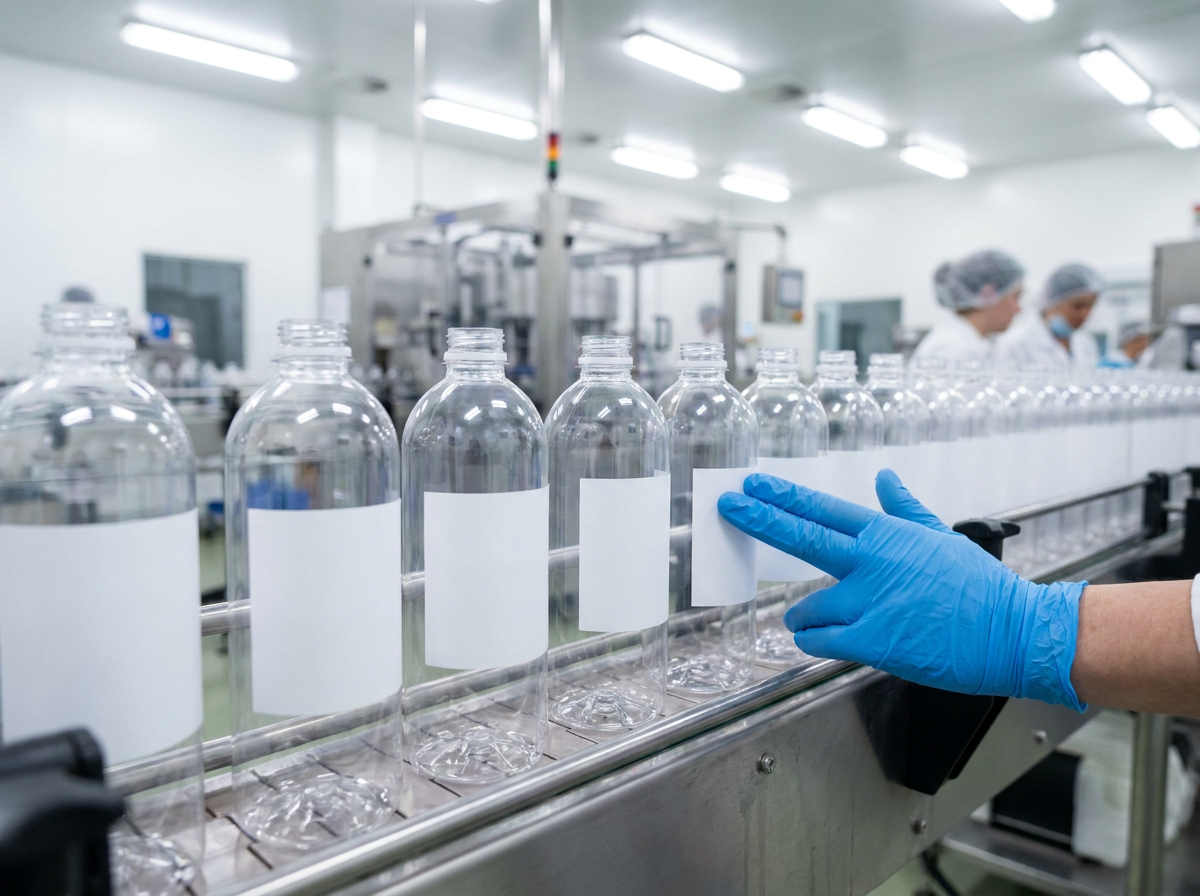
A bottle label has a harder job than it looks. It has to grip a curved, slick plastic surface, survive moisture and handling, and still look sharp on the shelf. When it fails, you see lifted edges, wrinkles and labels sliding off. Most of those failures come from a few choices made before printing. Here is how to choose custom labels for plastic bottles so they stay put.
Start with the bottle and what goes in it
Before you pick a label, write down what you are labeling. The container and the contents set the requirements for everything else.
Plastic bottles and containers vary a lot. Some are rigid and smooth. Others are squeezable and flex every time they are used. Some are stored cold, and some sit in humid rooms or get wet in use.
- Container material and finish: glossy, matte or textured plastic.
- Shape: straight sides, tapered, or heavily curved.
- Flex: rigid, or squeezed during use.
- Contents: water-based, oily, or food and beverage products.
- Storage and use: room temperature, refrigerated, frozen or wet.
Pick a label material that fits the job
Label stock comes in paper and film families, and the choice matters on plastic.
Paper labels are fine for dry, rigid containers that stay indoors. They can wrinkle or lift when moisture gets under the edge. Film labels, such as polypropylene, handle moisture better and move with flexible bottles.
- Dry, rigid containers: a paper label is often enough.
- Squeezable bottles: a flexible film label follows the bottle without wrinkling.
- Cold, wet or humid conditions: choose a moisture-resistant film.
- Premium look: a clear film label can give a no-label appearance on clear bottles.
Related: Custom product labels
Match the adhesive to the plastic
Adhesive is where many bottle labels go wrong. Some plastics have low surface energy, which means standard adhesives have a hard time bonding. A label that looks fine on day one can lift after a week.
Tell us the plastic type if you know it, and where the product will be stored and used. That lets us recommend an adhesive suited to the surface and the conditions.
- Permanent adhesives suit most retail bottles that should not come off.
- Cold and freezer use needs an adhesive made to bond at low temperatures.
- Food and beverage products need adhesives suited to the application. Our labels use FDA direct food contact adhesive.
- Always test a few labels on real bottles before a full run.
Size the label for a curved surface
A flat label wrapped around a curve behaves differently from a flat label on a box. If the label is too tall for a tight curve, the edges lift. If it is too wide, the ends overlap or leave a gap.
Measure the flat, usable label panel on the bottle, not the whole bottle. Stay clear of ridges, seams, shoulders and the base, because labels do not bond well over them.
- Measure the height and width of the smooth label panel.
- Leave a small margin around the label so it does not touch ridges.
- Decide whether you need a wrap-around label or a front panel and back panel.
- Keep important text and barcodes away from the seam or edge.
Plan the print: barcodes, text and color
Good label content is clear and readable at the distance people see it. If the product is sold at retail, the barcode has to scan on a curved surface too.
Keep barcodes on the flattest part of the label with plenty of quiet space around them, and use strong contrast between the bars and the background. If you need help with barcode registration or sizing, we handle that in-house.
- Use high contrast between text and background.
- Keep the barcode on a flat area, not across a seam.
- Check that the font size is readable at shelf distance.
- Match brand colors by sending us your color values.
Related: Barcode labels
Check how the labels will be applied
The best label still fails if it is applied badly. Think about how labels will go on the bottles before you order.
Hand application works for small runs. For larger volumes, an applicator keeps placement even and speeds up the line. Roll size, core size and unwind direction have to match your equipment, so tell us what you use.
- Clean, dry bottles give the best bond.
- Press the label down firmly, working from the center outward.
- Let the adhesive set before wet handling or chilling when possible.
- Give us your applicator details so rolls arrive ready to run.
Order from a manufacturer that proofs first
We are a Florida manufacturer with more than 40 years in the label industry. We design, print and ship in-house, with no brokers in the middle.
You get a proof within 24 hours so you can approve size, layout and content before anything is printed. We are open 8am to 8pm, seven days a week, so questions get answered when you need them. Send us your bottle details and we will help you choose the material, adhesive and size.
Related: Get a free quote
Frequently Asked Questions
What is the best label material for plastic bottles?
It depends on the bottle and conditions. Paper can work for dry, rigid containers. Film labels handle moisture better and flex with squeezable bottles. Tell us how the bottle is used and we will recommend one.
Why do labels peel off plastic bottles?
The usual causes are an adhesive that does not suit the plastic, a dirty or wet surface at application, a label that is too large for the curve, or moisture and cold the label was not made for.
Can you print labels for food and beverage containers?
Yes. Our labels use FDA direct food contact adhesive and food-safe materials. Tell us what the product is and how it is stored so we can match the stock.
How fast can I see a proof?
We send proofs within 24 hours so you can approve the design before production begins.
Need Custom Labels or Packaging Supplies?
Florida manufacturer, 40+ years of experience, proofs in 24 hours. Open 8am to 8pm, seven days a week.
Get a FREE Quote