RFID Labels vs. Barcodes: Which Is Right for Your Retail Business?
February 10, 2026 · 7 min read
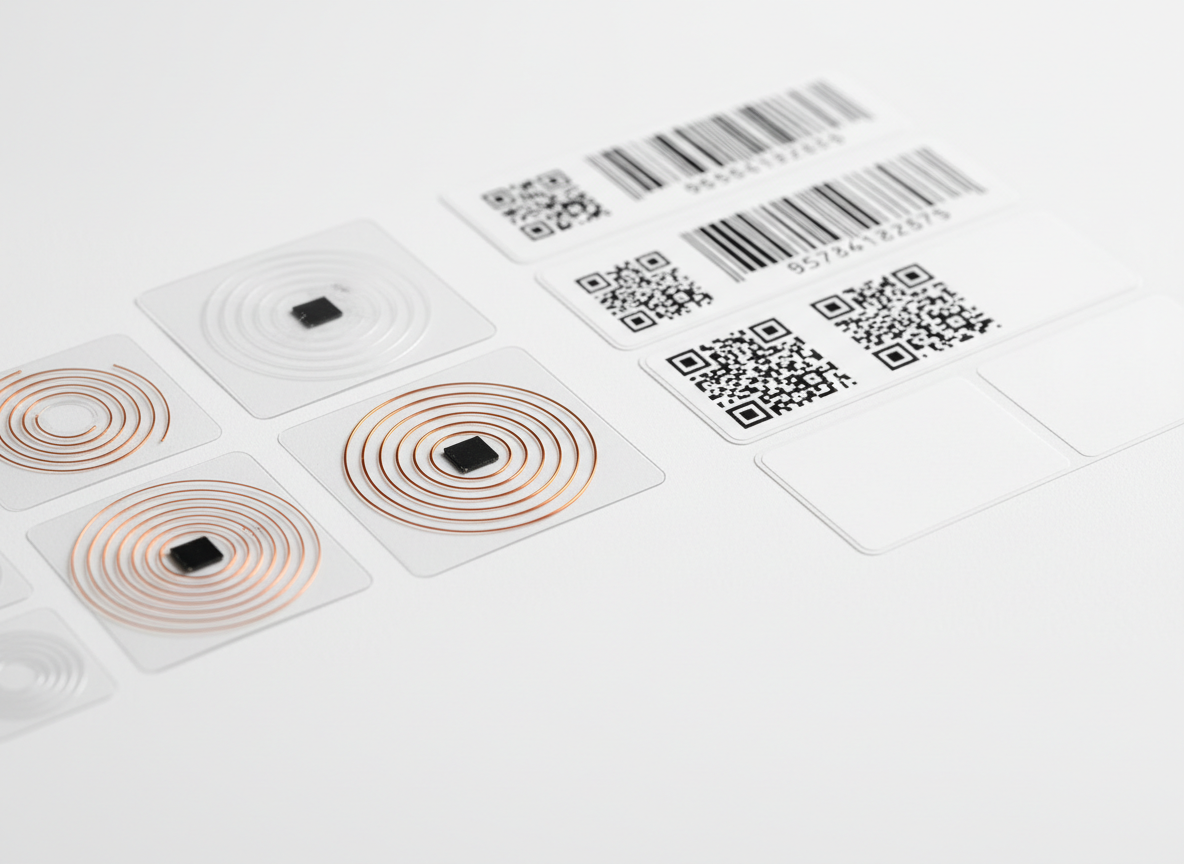
Both RFID and barcodes track products — but they work in fundamentally different ways. Choosing the wrong one can cost you time, money, and accuracy. Here's an honest comparison.
How Barcodes Work
Barcodes encode data as a series of parallel lines that a laser or camera scanner reads optically. Each item must be individually scanned — one at a time, with line-of-sight to the scanner. Barcodes have been the retail standard for over 50 years and are universally supported by point-of-sale systems worldwide.
How RFID Labels Work
RFID (Radio Frequency Identification) labels contain a tiny microchip and antenna. An RFID reader emits radio waves that power the chip and read its data — without line-of-sight and without scanning items one by one. A single RFID reader can scan hundreds of items simultaneously in seconds.
Head-to-Head Comparison
| Feature | Barcode | RFID |
|---|---|---|
| Scan speed | 1 item at a time | 100s of items at once |
| Line of sight required | Yes | No |
| Read range | Inches | Up to 30+ feet |
| Cost per label | $0.001–$0.01 | $0.10–$0.50+ |
| Reader cost | Low ($50–$500) | Higher ($500–$3,000+) |
| Data capacity | Limited | Much more data |
| Rewritable | No | Yes (some) |
| Industry adoption | Universal | Growing rapidly |
When Barcodes Are the Better Choice
- You have a small operation with limited SKUs
- Your POS system is barcode-based and upgrading isn't feasible
- You need the lowest possible per-label cost
- You're in an industry where RFID adoption is still low
- Your products contain metal or liquid (which can interfere with RFID signals)
When RFID Labels Are Worth the Investment
- You manage large inventory volumes across multiple locations
- Inventory accuracy is critical — shrinkage and stockouts are costing you money
- You want real-time inventory visibility without manual counts
- You're working with retailers (like Walmart or Target) who require RFID compliance
- You need to track items through a complex supply chain
The ROI Reality
RFID costs more upfront — but the ROI can be dramatic. Retailers using RFID report inventory accuracy improvements from around 65% to over 95%, and labor savings of 50–80% on cycle counts. For high-volume operations, RFID typically pays for itself within 12–18 months.
Can You Use Both?
Absolutely — and many retailers do. A common approach is to use barcodes for point-of-sale scanning (since all POS systems support them) while adding RFID capability for back-of-house inventory management. This gives you the best of both worlds without replacing your existing checkout infrastructure.
At PLU Label Stickers, we manufacture both barcode labels and RFID labels, and can help you determine the right solution for your specific operation. Contact us for a free consultation.
Related Articles
Need RFID or Barcode Labels?
Get a free quote — we manufacture both and can help you choose the right solution.
Get a FREE Quote