How to Choose Strapping for Palletized Shipments
· 7 min read · By Rob Puzio
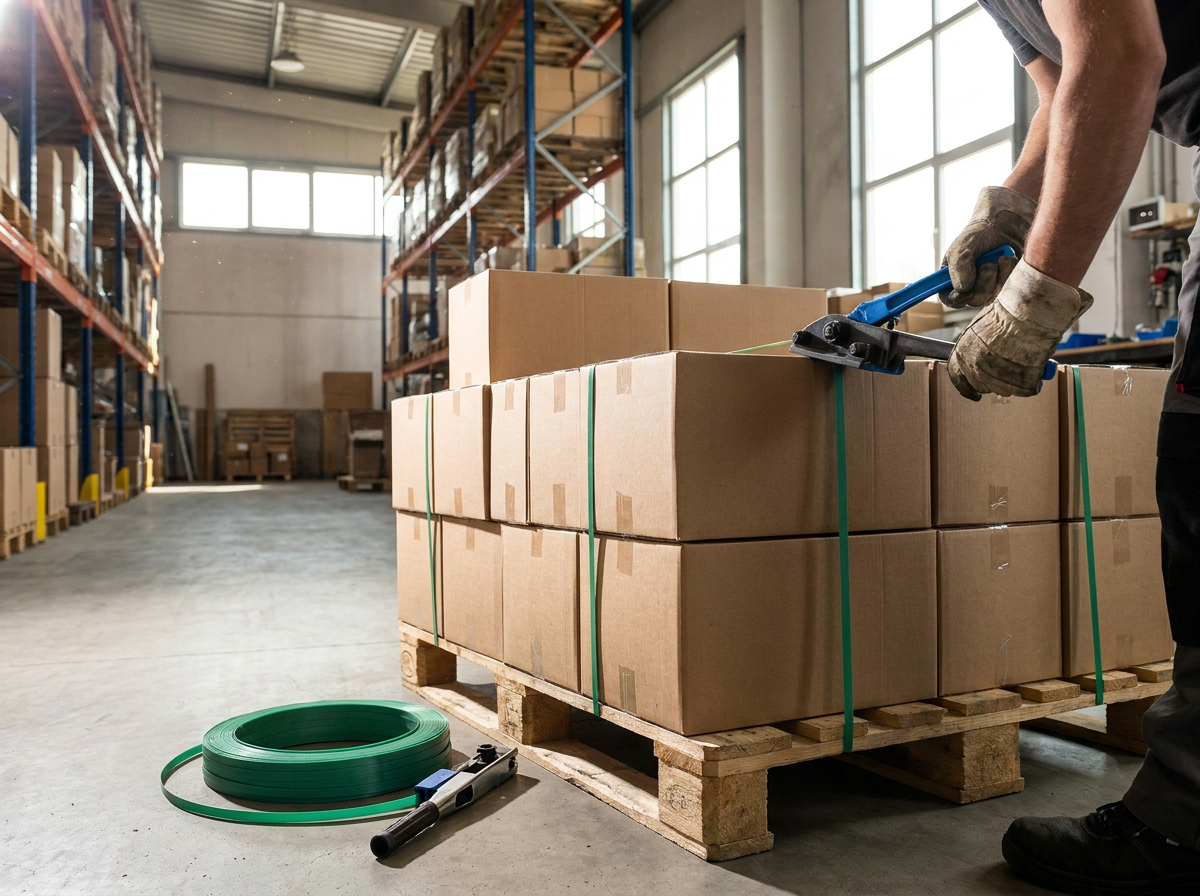
A pallet that shifts, leans, or comes apart in transit costs you product, time, and customer trust. Strapping is one of the simplest ways to prevent that, but only if you match the material and width to the load. This guide walks through the main strapping types, how to size them, and which tools you need, so you can order with confidence.
What Strapping Does on a Pallet
Strapping holds a load together and, in many cases, holds it to the pallet. It works alongside stretch film, corner protection, and good stacking. Film keeps the surface of the load wrapped, while strapping provides the tension that keeps heavy or dense stacks from moving.
Think of strapping as the structural layer. If your product is heavy, bundled, or prone to shifting, film alone is often not enough.
- Unitizing: keeping boxes or bundles together as one load.
- Securing: fixing the load to the pallet base.
- Closing: bundling items such as lumber, pipe, or flat goods.
The Three Main Strapping Materials
Most pallet strapping falls into three groups: polypropylene, polyester, and steel. Each has a place, and the right one depends on weight, load stability, and budget.
- Polypropylene (PP): light to medium loads. It is economical and easy to use, but it can lose tension over time as it relaxes.
- Polyester (PET): medium to heavy loads. It holds tension better than polypropylene and is a common replacement for steel on many jobs.
- Steel: the heaviest, sharpest, or most rigid loads. It has very high strength but needs more care to handle, and edges can be hazardous.
Matching Strapping to Your Load
Start with what you ship. A pallet of lightweight cartons that stack square needs far less than a pallet of dense, settling product.
Consider whether the load will compress or settle after strapping. Products that settle can loosen polypropylene, so a material that keeps tension, such as polyester, may be the better choice. Rigid loads that do not settle, such as stacked lumber or metal, are where steel is most often used.
- Light cartons and bundles: polypropylene.
- Heavy boxed goods and loads that settle: polyester.
- Dense, rigid, or sharp-edged freight: steel.
- Mixed shipments: choose based on the heaviest, least stable pallet.
Width, Gauge, and Strength
Wider and thicker strapping carries more load. Strapping is sold by width and thickness, and suppliers list a break strength for each size. Choose a size where the break strength is comfortably above what the load needs, not right at the limit.
Do not guess on this. If you are unsure, tell us the weight of the pallet and what is on it, and we can point you to a sensible size.
- Narrower strapping suits light bundles and cartons.
- Wider, thicker strapping suits heavier, taller pallets.
- Check the break strength rating listed for the product.
Tools, Seals, and Tensioning
The strapping is only as good as the way it is tightened and sealed. Hand tools, manual tensioners, and battery-powered tools are all used, depending on volume. Plastic strapping is sealed with a metal seal or by friction or heat welding, and steel uses a seal crimped over the overlap.
Use seals that match the strapping width and type. A mismatched seal is a common reason straps slip.
- Low volume: manual tensioner and sealer.
- Higher volume: battery-powered tools save time and give consistent tension.
- Always match seals to strap width and material.
Placement and Safety Tips
Place straps so they hold the load evenly, and use edge protectors where strapping bears on a corner so the box is not crushed and the strap does not cut through. Pull to firm tension, not so tight it damages the product.
Wear gloves and eye protection when cutting and handling tensioned strapping, especially steel. Cut straps release energy suddenly, so cut with control and keep clear of the strap path.
- Use corner or edge protectors on soft cartons.
- Space straps evenly across the load.
- Use gloves and eye protection when cutting.
Where to Buy Strapping and Related Supplies
We are a Florida manufacturer with more than 40 years in the label and price marking business, and through American Price Mark we also supply strapping and containment products, stretch film, tapes, boxes, and other shipping supplies. You work directly with us, and we are open 8am to 8pm, seven days a week.
If your pallets also need labels, we make those in-house with proofs in 24 hours, so you can handle both from one supplier.
Related: Packaging and shipping supplies · Custom product labels · Get a free quote
Frequently Asked Questions
Is polyester strapping better than polypropylene?
Polyester holds tension better and handles heavier loads, so it suits medium to heavy pallets. Polypropylene is more economical and works for lighter loads.
Do I still need stretch film if I use strapping?
Often yes. Strapping provides tension and structure, while stretch film wraps the surface and helps keep the load clean and stable.
How tight should pallet strapping be?
Firm enough to hold the load without movement, but not so tight that it crushes cartons or damages the product. Edge protectors help on softer boxes.
Can you help me choose the right strapping size?
Yes. Tell us the pallet weight and what you ship, and we will help you pick a suitable material and size.
Need Custom Labels or Packaging Supplies?
Florida manufacturer, 40+ years of experience, proofs in 24 hours. Open 8am to 8pm, seven days a week.
Get a FREE Quote