How to Choose Corrugated Boxes for Shipping Heavy Items
· 7 min read · By Rob Puzio
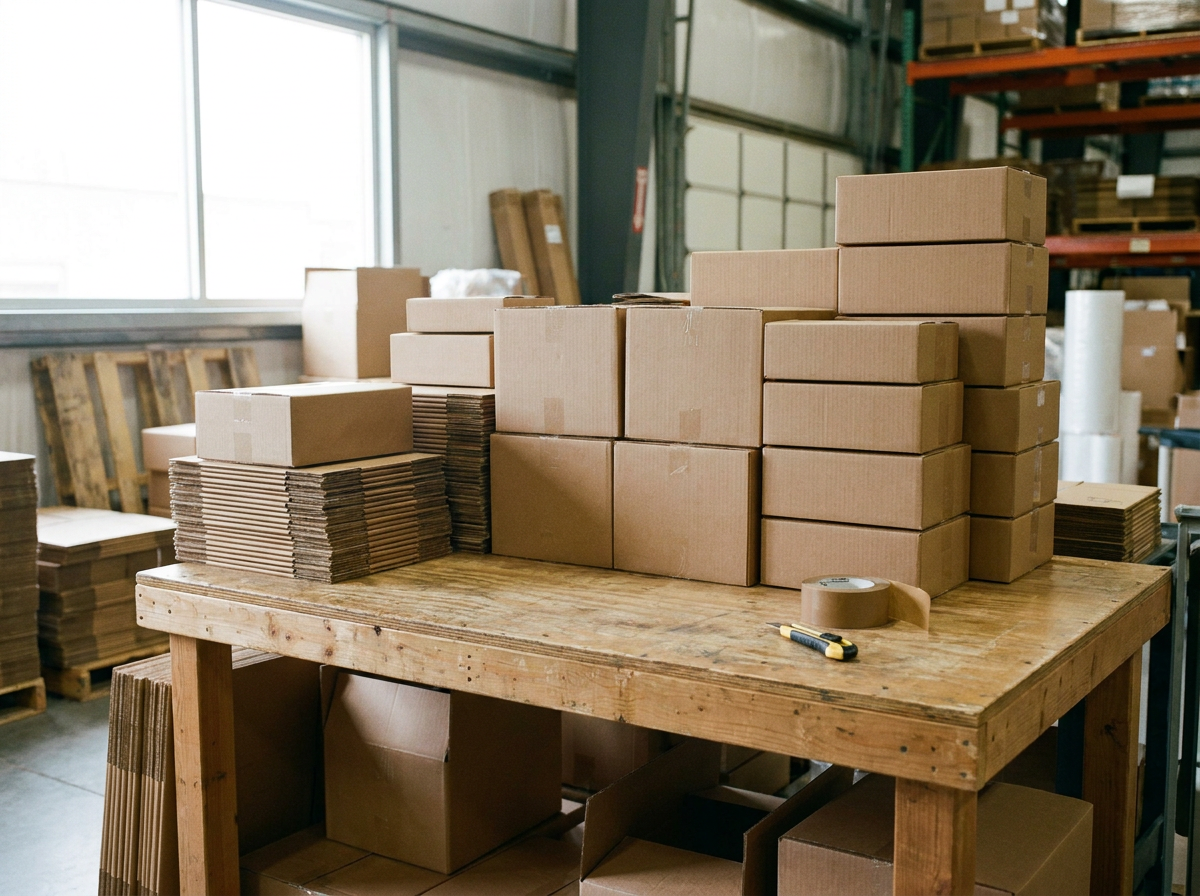
Heavy items punish weak boxes. Corners crush, bottoms blow out, and the product ends up in a damage claim. Choosing the right corrugated box is not complicated once you know what the ratings mean and what to check. This guide walks through wall construction, strength ratings, sizing, closure, and packing so your heavy shipments arrive intact.
Start With the Real Weight and Shape of the Load
Before you look at any box, weigh the packed product, including inner packaging. Then note the shape. A dense, compact item concentrates force on the bottom and corners. A long item flexes in the middle.
Write down the weight, the longest dimension, and whether the item has sharp edges or points. These three facts drive every other choice.
- Weigh the product with all inner packing included.
- Note the longest side and any sharp or pointed edges.
- Decide how the box will travel: parcel carrier, freight, or pallet.
Single Wall vs Double Wall Corrugated
Single wall boxes have one layer of fluted board between two liners. They work well for lighter loads. Double wall boxes add a second flute layer and a third liner, which gives much more stacking and puncture strength.
For heavy items, double wall is usually the safer choice. It costs more per box, but a damage claim costs more than the difference.
- Single wall: lighter products and short, simple trips.
- Double wall: heavy, dense, or stacked loads.
- When in doubt on a borderline weight, step up one grade.
Understand ECT and Burst Ratings
Corrugated boxes are commonly rated two ways. Edge crush test, or ECT, measures how much load the board can take on its edge, which relates to stacking strength. Burst strength, or Mullen, measures resistance to being pushed through.
Many suppliers print a rating on the box maker's certificate, usually on the bottom flap. Check that the rating matches the weight you plan to ship, and ask your supplier what the box is rated for if it is not clear.
- ECT: better guide for stacking and pallet loads.
- Burst strength: better guide for puncture and handling.
- Ask for the rating in writing for heavy shipments.
Get the Size Right
Size matters as much as strength. A box that is too large lets the product move and invites crushed walls when the void is empty. A box that is too tight leaves no room for cushioning and bulges at the seams.
Measure the product, then add room for cushioning on every side. Use inside dimensions when you compare boxes, listed as length, width, then height.
- Use inside dimensions, not outside.
- Leave space for protective packaging on all sides.
- Avoid boxes much larger than the item. Fill voids instead.
Close and Reinforce the Box Properly
Even a strong box fails if the closure is weak. Heavy boxes should be sealed with quality carton tape along the center seam and across both edges, using the H-tape method. Add extra tape on the bottom, where most blowouts begin.
For very heavy loads, consider strapping or a bottom pad for added support. A strong closure is cheap protection.
- Use the H-tape pattern on the top and the bottom.
- Choose tape rated for the weight and the temperature range.
- Add strapping or a bottom pad for very heavy loads.
Pack With Cushioning and Label Clearly
Protect the product from moving inside the box. Use protective packaging such as foam, paper, or air cushions to keep it centered, and keep heavy items away from the walls.
Finish with a clear shipping label and a barcode label that scans cleanly. Labels on heavy freight get handled roughly, so place them on a flat surface and keep them away from seams and tape.
- Center the item and fill all voids.
- Place labels on a flat panel, not on a seam.
- Add handling marks for heavy or fragile freight.
Related: Barcode labels · Custom product labels
Buy Packaging and Labels From One Florida Source
We are a Florida manufacturer with more than 40 years in the label industry. Through American Price Mark we also supply boxes, corrugated supplies, tapes, strapping, stretch film, and other shipping and warehouse supplies at competitive prices.
Need labels for your boxes or products? We send proofs within 24 hours and are open 8am to 8pm, seven days a week.
Related: American Price Mark packaging supplies · Free quote
Frequently Asked Questions
Should I use single wall or double wall boxes for heavy items?
Double wall is usually the safer choice for heavy, dense, or stacked loads. Single wall suits lighter products. If your weight is borderline, step up one grade.
What does ECT mean on a corrugated box?
ECT stands for edge crush test. It measures how much load the board can handle on its edge, which relates to stacking strength.
How do I stop the bottom of a heavy box from failing?
Seal the bottom with the H-tape pattern, add extra tape on the bottom seam, and consider a bottom pad or strapping for very heavy loads.
Can you supply boxes as well as labels?
Yes. Through American Price Mark we offer boxes, corrugated supplies, tapes, strapping, and other packaging supplies, along with custom labels.
Need Custom Labels or Packaging Supplies?
Florida manufacturer, 40+ years of experience, proofs in 24 hours. Open 8am to 8pm, seven days a week.
Get a FREE Quote