Custom Labels for Glass Jars: What Works for Sauces and Preserves
· 7 min read · By Rob Puzio
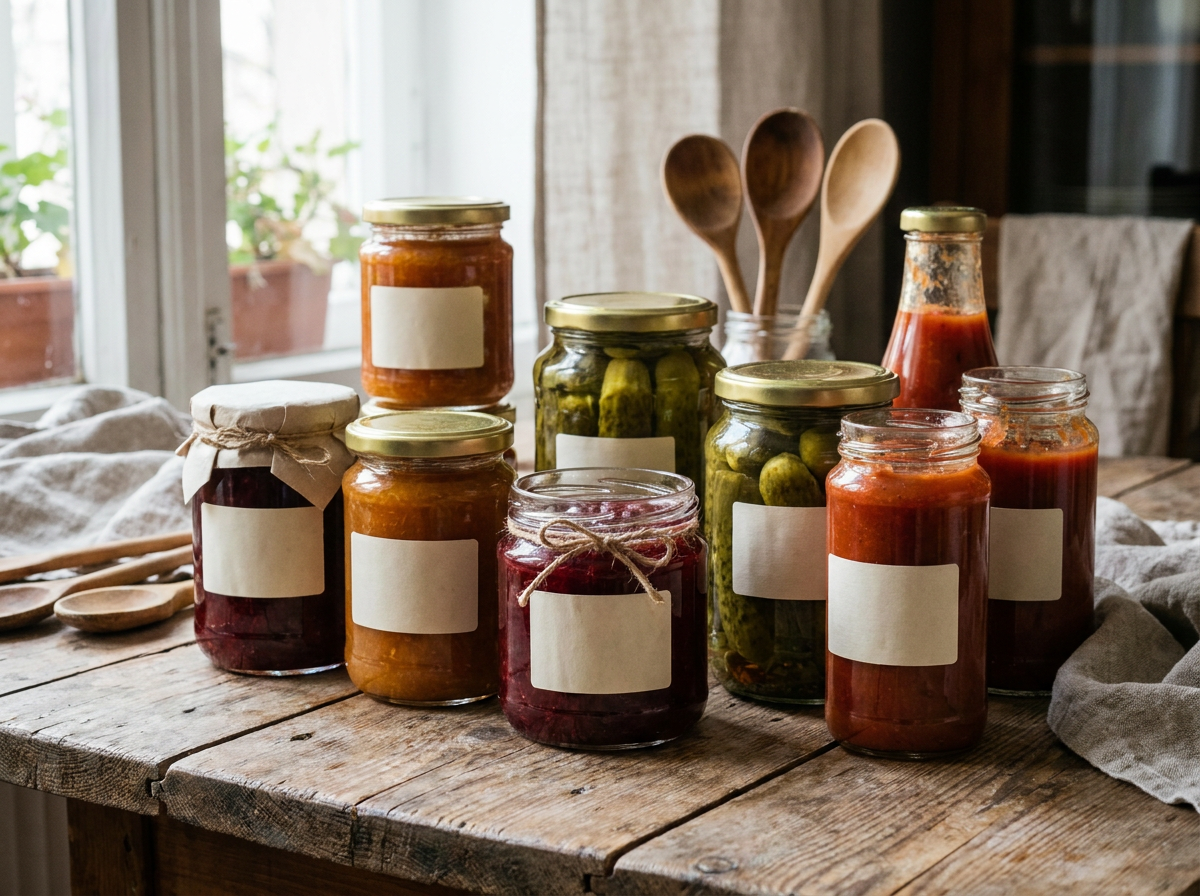
Glass jars are a great package for sauces, salsas, jams, and preserves, but they are tough on labels. The surface is smooth and curved, the contents can be oily or wet, and the jar may sit in a cooler or a fridge. A label that looks fine on the bench can peel, wrinkle, or smear within days. This guide covers what to specify so your custom labels for glass jars hold up.
Why Glass Jars Are Hard on Labels
Glass does not absorb anything, so the adhesive has to do all the work. Add the curve of the jar, condensation from cold storage, and oil or sauce on the outside after filling, and a basic label has a hard time staying put.
The fix is not complicated. Choose the material, adhesive, and size for the real conditions the jar will see, not just for how it looks on a shelf.
- Smooth glass offers no grip, so adhesive choice matters.
- Curved sides punish labels that are too tall or too stiff.
- Moisture and oil can lift edges and smear ink.
Pick the Right Label Material
Paper labels are common and look great on dry or shelf-stable products. For jars that get wet, chilled, or handled with oily hands, a synthetic material such as polypropylene resists moisture and tearing far better than uncoated paper.
If your jars go through a cooler or end up in a customer's fridge, lean toward a moisture-resistant material. It costs little more to specify up front than to replace a rejected batch later.
- Paper: good for dry, shelf-stable products with a natural look.
- Polypropylene or other synthetics: better for moisture, oil, and refrigeration.
- Matte or gloss finish: choose for the look you want, then confirm it holds the ink.
Use Food-Safe Adhesive
Even though a jar label does not usually touch the food itself, labels on food products should still use food-safe materials. Our labels use FDA-compliant direct food contact adhesive, which keeps one less thing to worry about if a label is ever near product.
Tell us about your conditions. A jar filled hot, cooled, and refrigerated needs an adhesive that bonds well to cold, damp glass. We match the adhesive to how you fill, store, and ship.
Related: Custom product labels
Get the Size and Shape Right
Measure the flat label panel on the jar, not the full circumference. Leave a small margin from the lid and base so the label does not touch the curve where it would lift. Wrap labels that go most of the way around need accurate sizing so the ends meet cleanly or leave a neat gap.
Front labels, back labels, and neck labels each serve a purpose. A front label sells the product. A back label can carry ingredients, a nutrition panel, and a barcode.
- Front label: brand, product name, and key claim.
- Back label: ingredients, nutrition, and contact details.
- Neck or lid label: tamper-evident seal or flavor callout.
Plan for Barcodes and Required Information
If you sell through retail, the jar needs a scannable barcode with clear space around it and enough contrast to read. Food labels also carry required information such as the product name, ingredients, and net quantity. Check current labeling rules for your product before you finalize a design, and confirm your buyer's requirements.
We handle barcode setup and layout in-house, so the code on your proof is ready to scan.
Related: Barcode labels
Think About Application and Volume
Hand application works for small batches. As volume grows, a label applicator saves time and keeps labels straight. Tell us which machine you use, or are considering, and we will build the roll to fit it: the right core size, direction of unwind, and label spacing.
- Small runs: hand application with accurate sizing.
- Growing volume: semi-automatic applicator for straight, consistent placement.
- Higher volume: confirm roll diameter and core before ordering.
Proof First, Then Print
We are a Florida manufacturer with more than 40 years in the label industry, and we do the design, proofing, and printing under one roof. Send us your jar details and we will recommend a material, adhesive, and size, then send a proof within 24 hours. We are open 8am to 8pm, seven days a week.
Related: Get a free quote · Custom product labels
Frequently Asked Questions
What kind of label is best for glass jars?
It depends on the contents and storage. Paper works for dry, shelf-stable products. For refrigerated or oily jars, a moisture-resistant synthetic material holds up better.
Will jar labels stay on in the refrigerator?
They can, if the material and adhesive are chosen for cold, damp glass. Tell us your storage conditions so we can match them.
Can I use a label applicator with custom jar labels?
Usually yes. Send the make and model and we will build the roll to fit it.
Do I get to see a proof before printing?
Yes. Proofs go out within 24 hours so you can check size, layout, and legibility before production.
Need Custom Labels or Packaging Supplies?
Florida manufacturer, 40+ years of experience, proofs in 24 hours. Open 8am to 8pm, seven days a week.
Get a FREE Quote