Barcode Label Sizes for Shipping and Retail Products: How to Choose
· 7 min read · By Rob Puzio
Barcode problems usually start with size. A label that is too small forces a tiny barcode, and a tiny barcode fails at the scanner. Shipping cartons and retail products need different sizes, different layouts, and different amounts of white space. This guide covers how to choose barcode label sizes for both, what the quiet zone is, and how your printer and package limit your options.
Shipping Labels and Retail Labels Are Not the Same Job
A shipping label identifies a carton as it moves through a warehouse or carrier network. It is scanned by handheld guns and fixed scanners, often at a distance and sometimes at speed. A retail label identifies a product at the register, where it is scanned at close range by a point-of-sale scanner.
Because the scanning conditions differ, the label sizes differ too. Start by deciding which job the label has to do, then choose the size.
- Shipping and warehouse labels: larger, built for distance and speed.
- Retail product labels: smaller, built for close-range checkout scanning.
- Produce and small packages: very limited space, so layout matters more.
Common Label Sizes for Shipping Cartons
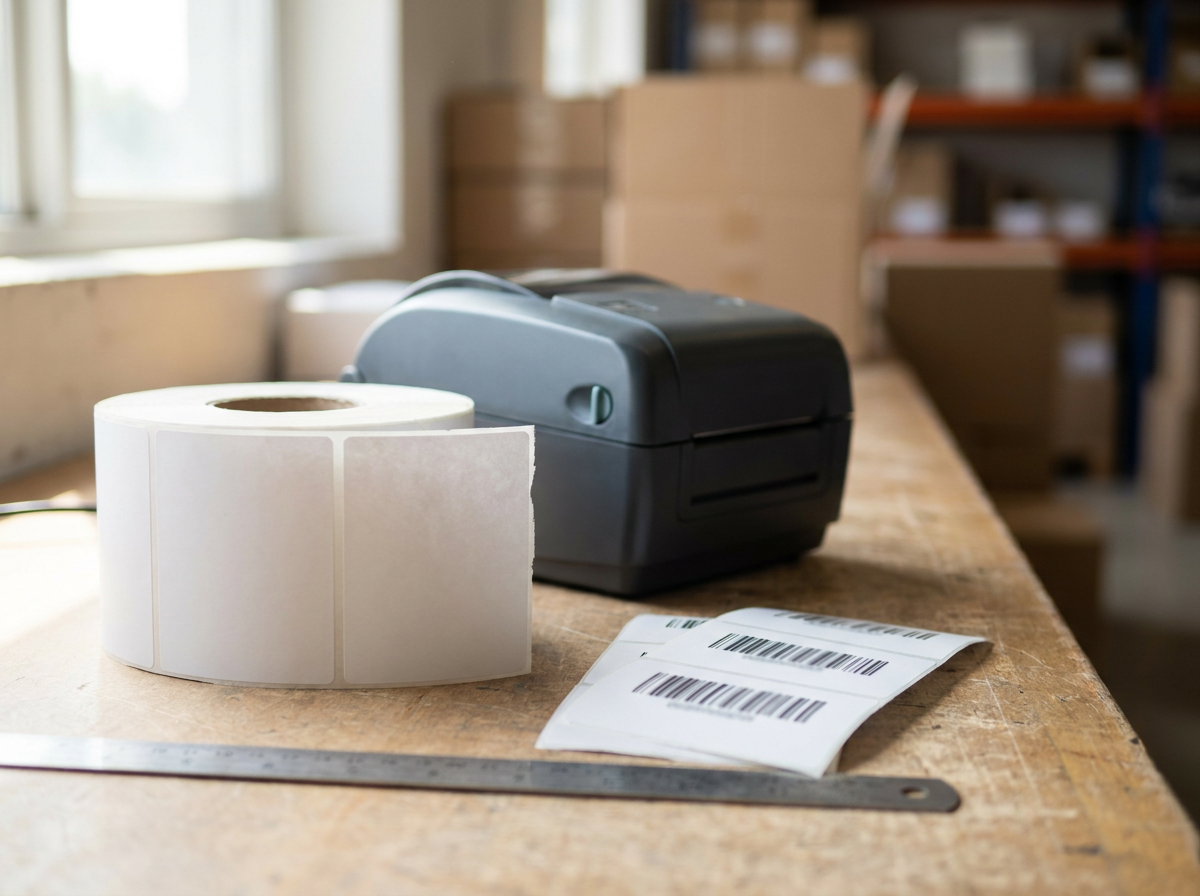
Most carton labels are printed on thermal printers using rolls. The most common sizes are 4 x 6 inches for carrier shipping labels and smaller formats such as 4 x 2 or 4 x 3 inches for inventory, location, and case labels.
A 4 x 6 label gives you room for addresses, routing information, and a large barcode. Smaller labels work well for shelf and bin identification, where you only need a code and a short line of text.
- 4 x 6 inches: carrier shipping labels and full carton information.
- 4 x 3 and 4 x 2 inches: case, bin, and inventory labels.
- Check your printer's maximum label width before you order rolls.
Common Label Sizes for Retail Products
Retail barcodes follow standards such as UPC-A. The nominal size of a UPC-A symbol is about 1.5 inches wide by 1 inch tall, and it is designed to be printed within a range of magnification. Retailers often have their own requirements, so confirm them before you finalize artwork.
Do not shrink a barcode to fit a small label. Reducing it too far hurts scan rates. If the product is small, it is better to change the label shape or placement than to squeeze the code.
- Keep the barcode at or near its nominal size when you can.
- Confirm the retailer's size and placement rules first.
- Choose a label shape that fits the package, not the other way around.
Do Not Forget the Quiet Zone
The quiet zone is the blank space on each side of a barcode. Scanners use it to find where the code starts and stops. If text, borders, or package edges crowd that space, the scan can fail even when the bars themselves are perfect.
Build the quiet zone into the label size from the start. A label that is only just wide enough for the barcode has no margin for printing variation or placement drift.
- Leave clear white space on both sides of the barcode.
- Keep graphics, borders, and text out of the quiet zone.
- Allow a little extra width for placement variation on the line.
Match the Barcode to Your Printer and Print Quality
Your printer sets limits. A 203 dpi printer can produce clean barcodes at normal sizes, while smaller or denser codes benefit from higher resolution. If the bars print fuzzy or uneven, the best size in the world will not help.
Contrast matters too. Dark bars on a light background scan best. Check that your label material and ink or ribbon give a solid, consistent print, and test a sample before you commit to a large run.
- Check printer resolution against the smallest bar width you need.
- Use dark bars on a light, matte background.
- Test-scan a sample at the distance and angle used in real handling.
Consider the Surface, Placement, and Handling
The surface the label sits on affects how it scans. A label that wraps around a tight curve distorts the bars. A label across a seam or fold can tear or lift. Place barcodes on flat areas, away from edges, seams, and tape.
Think about the environment as well. Moisture, cold, dirt, and abrasion all shorten label life. The right material and adhesive keep the barcode readable from the packing line to the final scan.
- Place barcodes on flat panels, away from seams and edges.
- Choose material and adhesive for the real conditions.
- Keep the orientation consistent so scanners find it quickly.
Related: Barcode labels · Custom product labels
Get Barcode Labels Made to the Right Size
We are a Florida manufacturer with more than 40 years in the label industry. We make custom barcode and product labels to your size, material, and layout, and we send proofs within 24 hours so you can check the size and placement before production.
We are open 8am to 8pm, seven days a week. For boxes, tapes, and other shipping supplies, American Price Mark also offers packaging products at competitive prices.
Related: Free quote · American Price Mark packaging supplies
Frequently Asked Questions
What size is a standard shipping label barcode?
Most carrier shipping labels are 4 x 6 inches, which leaves room for a large, easy-to-scan barcode. Smaller 4 x 3 and 4 x 2 inch labels are common for cases, bins, and inventory.
What size is a UPC-A barcode on a retail product?
The nominal size of a UPC-A symbol is about 1.5 inches wide by 1 inch tall. Check your retailer's requirements, and avoid shrinking the code too far.
What is a barcode quiet zone?
It is the blank space on each side of the barcode. Scanners use it to detect where the code begins and ends, so keep text and graphics out of it.
Can you make custom barcode labels to my size?
Yes. We make custom barcode and product labels to your size and material, and we send proofs within 24 hours.
Need Custom Labels or Packaging Supplies?
Florida manufacturer, 40+ years of experience, proofs in 24 hours. Open 8am to 8pm, seven days a week.
Get a FREE Quote